
U.S. Seeks Global Anti-Terrorism Coalition
19/04/2001| IslamWeb
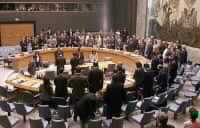 WASHINGTON (Reuters) - The United States said on Wednesday that it was trying to build a global coalition against ''terrorism,'' including allies, Russia, China and Muslim states, after the World Trade Center and Pentagon attacks. (Read photo caption below)
President Bush spoke with the leaders of the four other permanent members of the U.N. Security Council -- Britain, China, France and Russia -- during the day, and Secretary of State Colin Powell conferred with officials of other states.
``We will rally the world. We will be patient. We'll be focused, and we will be steadfast in our determination,'' Bush said in a statement after meeting his top national security aides.
``This is a moment for the world to stand up to terrorism, and President Bush is very pleased with the reactions of leaders around the world,'' White House spokesman Ari Fleischer told reporters.
Washington's NATO allies set the stage for concerted action, concluding that the attacks, which wrecked the twin towers of the World Trade Center and closed down the city's financial district, should be seen as an act against them all.
This means that once the United States knows who was behind the attacks, NATO can, in the words of Article V of its founding treaty, take ``such action as it deems necessary.''
Fleischer said, ``The president will continue to reach out to leaders throughout the world to develop this coalition, to send a message that the United States and the world stand united, all the freedom-loving countries and others, to fight terrorism.''
A senior State Department official, speaking on condition of anonymity, put it more starkly: For Washington, the world falls into two categories -- for and against the United States.
TIME ``TO TAKE SIDES''
``We expect everybody to take sides,'' the official said. ''It's time for people to say what they are and act like it.''
Bush said earlier Washington would act against not only the perpetrators of the attacks but any state that harbored them.
Powell said he also wanted backing from Muslim states. A senior State Department official said he had spoken to Arab League Secretary-General Amr Moussa and officials of Jordan and Egypt.
``We will hold accountable those countries that provide support ... and facilities to these kinds of terrorist groups,'' Powell said.
The United States has accused Afghanistan of harboring Saudi-born dissident Osama bin Laden, the man who Washington says was behind earlier attacks on U.S. Embassies in East Africa and whom many Americans believe is behind the latest mayhem.
Bin Laden, a wealthy Saudi exile who lives in Afghanistan, has vowed to strike at U.S. targets in the past.
One country whose cooperation Washington is seeking is Pakistan, considered the main international backer of the Taliban, Afghanistan's hard-line Islamic rulers. The Taliban are also recognized by the United Arab Emirates.
Saudi Arabia's backing for the Taliban is less clear. One of bin Laden's goals is to overthrow the government of the U.S. ally that let in U.S. troops to attack Iraq.
Saudi Arabian Ambassador Bandar Saud told a news conference he had been in constant contact with Powell and had promised help fighting terrorism, though he said it was premature to discuss support for military action.
Powell said Deputy Secretary of State Richard Armitage met Pakistani officials in Washington, and the U.S. ambassador in Islamabad expects to see Pakistani President Pervez Musharraf on Thursday.
He said that first of all, the United States expected the ''fullest cooperation'' from Pakistan in gathering information about the attacks.
WORLD REVULSION
In the immediate aftermath of the attacks, all but a tiny number of countries expressed revulsion. Stiff rejections of the attacks came from such U.S. critics as Iran, Libya and Syria, suggesting a coalition might be a real possibility.
Anthony Cordesman of the Center for Strategic and International Studies said Washington was already exchanging information on ``terrorism'' with many countries, including Russia and China, that had agendas different from its own.
In this case, conflicting political interests and different interpretations of conflicts, where one country's ``terrorist'' is another's freedom fighter, can be set aside, Cordesman suggested.
``It's one thing to deal with political issues and freedom fighters. But those who kill several thousand people aren't freedom fighters. They're butchers,'' he said.
``Will it be a perfect coalition? Of course not. Can we do more? Yes. Will it be important? I think it will be vital.''
But when it comes to actual military action, things could get more complicated, said James Steinberg, former President Bill Clinton's deputy national security adviser.
The Russians, who blocked U.S. efforts to revamp sanctions against Iraq recently, had a motive to back Washington because of their fears about Afghan-related support for Chechens fighting for autonomy in the Russian region of Chechnya, he said.
``How far they'll go and how far they'll be prepared to associate with the U.S. if we use military force is more complex,'' he added.
Pakistan's case could be the toughest of all -- and the most crucial, given its ties to the Taliban.
Stephen Cohen of the Brookings Institution think tank said Pakistan had to decide which side it was on -- but it wanted to have it both ways, seeing Afghanistan as an important buffer.
The United States could offer Pakistan a more active role in solving the Kashmir issue, he said.
``It may be time to think about carrots and sticks. So far, there has been a policy of name-calling,'' he said.
PHOTO CAPTION:
Members of the United Nations Security Council pause in a moment of silence, September 12, 2001 to express it's condolences to the victims of the deadly attack on the World Trade Center and the Pentagon. The United States said that it was trying to build a global coalition against 'terrorism,' including allies, Russia, China and Muslim states. President Bush spoke with the leaders of the four other permanent members of the U.N. Security Council -- Britain, China, France and Russia -- during the day, and Secretary of State Colin Powell conferred with officials of other states. (Reuters - Handout)
www.islamweb.net