
UN member nations mobilize against terrorism
24/04/2001| IslamWeb
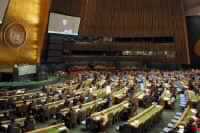 UNITED NATIONS, (AFP) -UN member states were to begin discussing Monday ways of stepping up the fight against terrorism after the Security Council adopted a resolution threatening sanctions against countries that do not deny support to terrorists. (Read photo caption below)
Diplomats believe that the General Assembly debate will demonstrate the international community's determination to combat terrorism, three weeks after the attacks on World Trade Center in New York and the Pentagon building near Washington, which have left more than 6,000 people dead or missing.
In a sign of unusual solidarity between the world body and the city that hosts its headquarters, New York Mayor Rudolph Giuliani is expected to address the delegates.
It is the first time since the inauguration of UN headquarters on the East River in Manhattan in 1952 that the mayor of New York has been invited to address the General Assembly.
UN Secretary General Kofi Annan will open the debate by stressing that only the United Nations could bring uncontested legitimacy to the fight against terrorism.
"In his speech he will emphasise that terrorism is a universal challenge, that the United Nations is uniquely positioned to address," said UN spokesman Fred Eckhard.
Many governments have expressed their reservations about getting involved in a war declared by the United States and indicated that it would be easier for them to take part in the anti-terrorism campaign under the auspices of the United Nations.
Annan was also to invite member states to sign and ratify without delay 12 existing international conventions against terrorism that remain generally unenforced.
For example, a convention against financing terrorism adopted in December 2000 has been ratified to date by only four countries.
However, debate among the 189 member states is promising to be more heated and controversial than among the 15 members of the Security Council, which adopted the anti-terrorism resolution on Friday night barely 24 hours after it was presented.
Diplomats believe the discussion will be affected by the Israeli-Palestinian conflict and the definition of terrorism, with Arab countries insisting it does not include acts of "resistance" against Israel.
The Syrian official newspaper As-Saoura wrote Saturday that the debate at the General Assembly would be an occasion to draw the line between resistance and terrorism, and discuss "state terrorism of Israel against the Palestinian people".
A definition of terrorism, carefully avoided by the Security Council, is expected to be introduced in a draft convention prepared by India, which is likely to take months to negotiate, according to diplomats.
According to British Ambassador Jeremy Greenstock, the definition of terrorism is not the only "gray area" in the council resolution.
Humans rights activists have expressed concern that a very restrictive resolution will be a blank check given to authoritarian governments to repress their opponents.
Greenstock said that laws of most countries will have to be modified to conform to the Security Council resolution.
Meanwhile, Eckhard expressed confidence will be able to resolve this problem.
"Governments here are trying to come to grips with a very serious threat, and to strengthen the procedures already in place to deal with terror," he said.
"Our hope is that that can be done in a fair as well as effective way, not affecting civil liberties and not leading to excesses by any government."
PHOTO CAPTION:
Dr. Han Seung-soo, president of the General Assembly at the United Nations, presides over the assembly Wednesday, Sept. 19, 2001, at the United Nations. The U.N. General Assembly has postponed its annual gathering of world leaders scheduled to begin next week because of security difficulties in the wake of last week's terrorist attacks. (AP Photo/David Karp)
www.islamweb.net